Saturday, 21 January 2012

Iconic homage

B217
Composition with Red, Blue and Yellow, 1930 is, perhaps the best known Mondrian abstract: designated B217 in the Catalogue, it is almost identical to B219 and to an uncatalogued gouache. The three are owned by the Kunsthaus, Zürich, thFukuoka City Bank and the Triton Foundation respectively.


Nick Blackburn


Given its iconic status, it is commonly the subject of homages and I'll show some here.

The first is mine from around 2002.


The second is an intriguing piece, Kompozicija II, from a Serbian web site which keeps disappearing, then popping up elsewhere. Here's the link at the time of writing.


Alexie Sayle
Alexie Sayle used the piece in his BBC Series. The sketch explores the assertion that everyone's first job is (and I quote) "shite". He covers Malcolm X, Joyce, Ghandi and PM: "The minimalist painter Piet Mondrian was a highly unsuccessful court artist for German television. This picture is entitled Scuffle breaks out between prosecuting counsel and defendant." A better image would be nice.

An advertisement for the Investors' Chronicle in The Spectator. Tinkered with and inverted, but still B217.


Katie Jackson
From a long and frequently brilliant series of remakes on booooooom, the suitcase remake is by Katie Jackson.

And finally, from the book Tidying Up Art by Ursus Wehrli. This is out of print and is set at silly prices on second-hand sites (e.g. £160 even from Oxfam). I don't believe anyone has ever paid more than £10 for it, but once one seller generates a random number, the others seem to follow suit. There is a German edition, Kunst aufräumen, which is sensibly-priced and might have the same contents, so I'll buy one of those and see.
Ursus Wehrli
I can confirm that the German edition contains the image and that it references the Kunsthaus Zürich work, B217. There are many other fine pieces covered, well worth buying. 


Heidi Mulder

A new addition in July 2012 is Heidi Mulder's Mondrian Nude 1. Full details in the Nude homages post.

Thursday, 19 January 2012

Marlow Moss

Time to remind anyone with an interest in Mondrian of the merits of Marlow Moss (1889-1958), his friend and reciprocal influence.
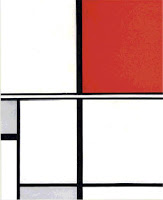
The recent Rome exhibition L'armonia perfetta included three of Moss's paintings, including White, black, red and grey, shown right.

Mondrian was a significant influence on Moss and many believe that she influenced him by introducing the double line.

Moss lived with Netty Nijhoff at Chateau d'Evreux, Gauciel in Normandy from 1937, but they fled to Holland and then to England in 1940. The Chateau was taken over by the French air force and in 1944 was destroyed in a bombing raid, along with most of Moss's life work and two Mondrians, lent to Moss by Wim and Tonia Stieltjes.

The literature available on Moss includes a book on the reconstruction of her works by Florette Djikstra, and a PhD thesis by Lucy Howarth, available from the British Library.


Friday, 2 December 2011

Mondrian flowers

I am assembling images of all the Mondrian Flower paintings I can find. Although dismissed by many writers as only being created because the abstracts weren't selling, and even if Mondrian resented having to paint them, I have enjoyed the research and think there are some real gems. They also played a clear role in the path towards abstraction.

The impetus behind this was finding a homage by Colin McCahon, Mondrian's chrysanthemum of 1908, 1971, shown on the link.


There are around 180 flower drawings and paintings overall: a more detailed analysis of the mediums used, subjects and whereabouts will follow.

I came within a reasonable distance of owning a Mondrian soon after developing my interest in the early 2000s: a flower watercolour popped up on eBay with what looked like a reasonable provenance, starting at $200 but only shipping to the USA. I would have been prepared to travel over to pick it up but the sale was withdrawn long before the end.

There is an interesting homage here.

The two images shown are:
C34 Amaryllis, 1907, pencil and watercolour on paper; and
C102 Dahlia, pencil and watercolour on lined paper, from the The Pierpont Morgan Library.

Wednesday, 2 November 2011

A new Mondrian painting

New to me, at least, and not shown in the Catalogue Raisonné 


Composition with Black, Red, Grey, Yellow and Blue c.1920 (left) is part of the promised gift of Julian and Josie Robertson, in memory of the latter, to Auckland Art Gallery Toi o Tāmaki. The piece is described as gouache with traces of pencil laid down on card, 27.8x19.1 cm


It bears a remarkable resemblance (with the exception of size, medium and one small black plane, middle left) to Tableau 1, with Black, Red, Yellow, Blue and Light Black, 1921, oil on canvas, 96.5x60.5 cm (right) which is in the Museum Ludwig, Cologne.

Sunday, 18 September 2011

Mondrian dresses

Yves Saint Laurent owned three Mondrians, including B142 Composition with Blue, Red, Yellow and Black, 1922 (left), acquired in 1972 (the others were bought in 1969 and 1980). In 1965, YSL created his first Mondrian-influenced dress. The sketch (right) is by Kenneth Paul Block. This blog suggests that Anne Klein thought of it first, but that YSL's implementation was superior.


There are some memorable contemporary photographs of the dresses. The photograph on the left, including B116, Composition with Yellow, Blue, Black, Red, and Grey, 1921, was used by the Hague Gemeentemuseum in publicity for their exhibition Fashion ♥ Art: A Passionate Affair, Sep 2011 - Jan 2012. On the right is, perhaps, the finest contemporary photograph of a YSL Mondrian dress, Isabel Eberstadt taken by Frederick Eberstadt.


More recently, Francesso Maria Bandini has extended the concept. More details in this blog.


More on Mondrian-influenced clothing here.

Sunday, 21 August 2011

Identifying Mondrian abstracts

I have been working on a straightforward method of identifying Mondrians from the 1920 lines-and-planes abstracts onwards. 


My solution is to count the number of coloured and black planes which gives a 4-digit code. I have listed all the Mondrians by this code and it is then just a question of matching the image in question. The colours are in the sequence red-yellow-blue, then black and so taking the example of B114, Composition with Yellow, Red, Black, Blue and Grey, 1920 on the left, this codes as 1212 and B239 Composition with Red and Blue, 1933 (right) as 2010.
The lookup page is here.


Note that some of the works no longer exist and have been reconstructed, and for some others, I do not have access to a colour image and those have been facsimilated.

Monday, 25 July 2011

Mondrian's studios

After leaving home to pursue his art studies and career in 1892, Mondrian occupied "many residences in and around Amsterdam over the next 20 years" [Bois et al].  He made short visits abroad to Cornwall with Hannah Crabb in the summer of 1900 and to Spain with Simon Maris in the summer of 1901. Within Holland, he spent time in Uden (1904), Oele (1906), Domburg (1908 and 1909) and Zeeland (1911). The first studio photograph is of Mondrian in his Rembrandtplein studio in 1905.

The second photograph (by R. Drektraan) is at Sarphatipark 52, Amsterdam, where Mondrian lived in 1909-10. The photograph was taken before he painted the floor black and the walls and furniture white.


In June 1911 he visited Paris for 10 days and in January 1912 moved to Paris, his first address being 33 avenue du Maine. In May 1912 he transferred to 26 rue du Départ, probably his favourite workplace. This photograph of the exterior was taken by by Alfred Roth in 1928.

He returned to Holland frequently: in 1914 he visited his father in Arnhem and could not return to France because of the outbreak of the First World War. He continued to pay quarterly rent on 26 rue du Départ during this enforced absence. Most of this period in Holland was spend in Laren, the photograph left shows his studio there.

Mondrian returned to Paris in June 1920. He first occupied another room at 26 as Marthe Donas was living in his old studio. In November he moved to 5 rue de Coulmiers where he decorated the walls with cardboard painted with primary colours, white and grey. The studio has been recreated in this blog and this video by Ryan Egel-Andrews.

In October 1921 Mondrian moved back to a larger studio at 26. He repainted it in May 1924. In 1926 Delbo photographed the studio and these images were used by Frans Postma to create 26, rue du Départ (published  1995),  a reconstruction which was also shown in the 2011 exhibition at the Pompidou Centre. Mondrian repainted the studio in July and August 1927.


Mondrian's last Paris studio was at 278 boulevard Raspail. He moved there in March 1936, immediately painted the walls white and soon added colour planes.
The photograph shows Mondrian with his brother Carel and Carel's wife Mary.


The threat of the Second World War caused Mondrian to leave Paris in September 1938: Winifred Nicholson travelled with him to London and helped him to set up in Hampstead, where many artists lived. He took a room and studio at 60 Parkhill Road. A bomb landed nearby in September 1940 and Mondrian moved back to the Ormande Hotel, Belsize Grove, where he first had stayed in London.


At the end of September, Mondrian boarded the Samaria in Liverpool and sailed to New York, arriving on 3rd October.


He stayed with Harry Holtzman at first, at his apartment and his summer home in the Berkshires.


Holtzman rented Mondrian an apartment on the third floor of 353 East 56th Street. Mondrian painted the walls white and added colour planes.


The 1942 photograph is by Arnold Newman.


He moved to 15 East 59th Street in October 1943: in this case, the walls were whitewashed in advance, leaving Mondrian to add the colour planes. The photograph, showing Victory Boogie Woogie was  taken by Holtzman a few days after Mondrian died on 1st February 1944. The studio was recreated for a 1995/96 MoMA exhibition.


Mondrian was buried at Cypress Hill Cemetary.